Friday, March 4, 2016

An Ode to My Grandfather, Charles S. Daniels, My First Storyteller


Good morning Facebook. Random thoughts popped into my head that must be shared.

1-Me at about 4 years old on Saturday and weekday mornings with my grandfather watching morning children's programming on PBS Channel 13, or Saturday morning cartoons (when they were good). He's in the kitchen frying bacon and eggs, with buttered toast and a large enamel mug of sweetened and creamed coffee that I will get just a few sips of. I was not in school yet, at this point, and distinctly remember everyone else in the house had already got up and left for their respective work and school, so it was just me and him those times.
2- A few years later, still with the Saturday morning cartoons. Around noon or 1pm, though, it was Grandad's turn to watch tv. The choice was either boxing on Spanish Language Channel 41 or 47 (Telemundo?), or whatever old rerun movie they were showing on Channel 7 (ABC) or 11(WPIX), which meant a lot of western movies, or Matlock. I would laugh when I watched Grandad's rapt attention to the small TV screen, feigning boxing himself, as we tried to decipher rapid-fire Spanish commentary.
3- We lived in The Bronx, and I was going to Brooklyn Technical High School. Any of you out there have a clue what kind of commute I endured for four years (in a two-fare zone, no less) will understand. It seemed like every month I found myself being excused from class to lay on a cot in the infirmary that first grueling day of my monthlies. My grandfather used to come from The Bronx and pick me up when I was too sick and delirious to go back to class. He went to the drugstore and bought my lady products.
4- Grandad was old and one year from dying of cancer at this point. But he was well and alert enough in 1999 to be a part of the family crew that escorted me to college way out in Southampton, Long Island. I have a picture of him with everybody else in the public quad area of my dormroom, outside the computer center, looking a little out of place, a shrinking dark-skinned black man whom I rarely saw smile. He was smiling and proud on that day.

2018 Update on his 101st birthday: In the midst of and beyond these specific events, Charles Daniels weaved a great yarn! He was a masterful storyteller, and kept meticulous notes that I find myself poring over as I work on a personal heritage project. It is because of him that I started remembering birthdates of my extended family, and tracing my lineage to four continents. Even when I wasn't certain whether I was hearing entire truth or embellishments of memory, I knew that I had a treasure trove of information from the stories my grandfather's oral and written traditions. My recent journey to Cyprus brought a lot of these thoughts back, and talking with my older cousin "Uncle" Walter D'Aguiar helped to fill in many gaps to the timelines.

The point of citing these distinct memories is that I want to promote and support the Men of Facebook that I know to emulate this kind of dedication and tenderness to their daughters, granddaughters nieces, step-children, any girl that you come across for a time, that you can influence with your authority, your love, your very presence. Aside from the 1st day of college, these were all fairly mundane days in my life, in his life. It rained, it snowed, he went to work, I woke up or went to school. But they will always be treasured memories for me. My grandfather had one daughter. I am her eldest of two. He had her over twenty years later in his life than my mother had me, so the age gap was pretty distinct in terms of parenting styles, but the values still stuck.

Credit where credit is due: this post was made possible by a particularly quiet and pleasant weekend morning, free from immediate pressing obligations and a full spirit. I attribute the manifestation of this from a Facebook status update to an actual blog post to two special ladies, however; my best friend @littlefootlady, and the awesome @Luvvie, for the gentle kicks in the pants!

~@Swaitespot

Thursday, February 25, 2016

Getting my WITS About Me: On Becoming A JourneyWoman

Reflections:

In keeping with my 2015 aim of tackling challenging tasks and reaching forth to grasp everything life has to offer, I booked my way to the 3rd annual Women In Travel Summit in Boston's Revere Hotel in March. This was a challenge for me, both in the financial arena as well as the logistical one.

I wanted to prove to myself that I could be my own travel agent; that I have the research savvy to connect accommodations and transportation schedules, in line with a planned event, in a way that maximized my comfort and enjoyment. What woman wants to be rushed and harried with scheduling conflicts, after all, on her way to a networking event focused on the empowerment of women through independent travel? I was determined not to be lost in the irony of bad planning (pun intended)!

The first task I set for myself was making my small budget work for the total event: meals, vendor purchases, the inevitable social club/bar meetup off-site with my new network friends. I figured whatever costs I incurred would be a tax write-off once I landed that lucrative travel-related job by the end of 2015, a veritable business-machine humming happily along.

I joined a travel writer/blogger group, Go Girl Travel Network (now relaunched as She's Wanderful), and secured a highly enviable discount as a bona fide member of Social Media. Now it was starting to feel real!

Although there was a strong pull to rush order some business cards in time for the conference, I decided to collect them instead and practice my virtual connections. I also wanted to gain some insights on the best way to rebrand myself, so I would not order them until I got those details figured out.

The most fun and rewarding out-of-the-box move I made was to join a book club not just to get more reading done, but as a networking medium for like-minded women travelers like myself. My first meeting with the New York Chapter of Go Girl Reads was held a mere two weeks before the conference,  and we tackled the groundbreaking autobiography by Cheryl Strayed, Wild. Strayed's book was a perfect ice breaker among the women in the book club, since we got to talk about not only our reactions to her amazing tale of determination, but also relate it back to what it means for us as women blazing our own trails.

As I anticipated would be part of the discussion at WITS, we discussed the practical logistics of being a biological woman in a less than ideal comfort zone, in transit. What does one do and use when she's menstruating, for example? What was an acceptable level of sociable connection while going solo, for safety, for preservation of one's mission and integrity?

Another poignant discussion point was the responsibility of being a Western-based female traveler. For me, this was interesting because there is a duality to my own perspective: I am of South as well as North America,  my worldview as a 1.5er very much influencing how I approach the road, and how I expect it to meet me. I am well aware of and learning so much more about the nuances of privilege from a traveler's context, so I strive to keep this sensitivity balanced as an advocate and writer.

Making connections in the reading group came naturally, since about four of us were going to the conference anyway. I made arrangements with on group member for a place to crash with her friends in Boston, and with another as part of her carpool. Eventually the carpool added a few other attendees, but the couch crash fell through. I dealt with it, and that led to my first Airbnb (stay tuned for another post about The Stranger's Couch).

In all of this planning and rearranging,  I learned what my sanity levels could withstand and how to face my travel anxieties. Knowledge is key for preparation, as is the willingness to try a different path than I've tried before. Results may not be guaranteed or predictable, but fueled by my desire to be less anxious and hesitant about stepping outside of my comfort zone, I've become a tad bit more social.

By osmosis, I've also developed more savvy with varying platforms of communication, the immediate benefit being way more connected to women that embody the fearless spirit to wander, seek truth and advocate positive power for and by women worldwide.

Perspective in travel is a valuable noun as well as adjective. I used to think that I could only call myself a traveler if I was leaving the United States. This thought process did not honestly attribute all of the wisdom imparted to me by my family and personal achievements, however. Yes, I did fly to Australia and study abroad for three months when I was 20 years old, but I also embarked on my first whirlwind bus-and-plane journey a year earlier, from New York to Atlanta to Toronto and back!

I appreciate Beth Santos and her team for the originality of such a network of independent and creative women, and look forward to pioneering new paths for women and young girls to go somewhere and do something meaningful!

Tuesday, February 23, 2016

On Going Home: A Pursuit of the Origins and Homecoming of Migratory Guyanese


I have always had a somewhat distant fascination with Guyana. The Co-operative Republic of Guyana (pronounced GUY- anna) turns 50 years old this year. As a New Yorker living in Brooklyn, this is no small bit of news. I was born in a nascent nation, merely out of its adolescence at the time of my birth. It is a unique experience for someone that has grown up in the United States for over 30 years, but I still identify as a #blackamazonian; this cannot be taken away from me. Republic Day is today, February 23rd, and there is cause for acknowledgement and reflection. What are we to celebrate, when it comes down to it?

Columbus allegedly stumbled upon this goldmine of a place as far back as 1498, and it changed hands with the Dutch, French and English throughout the next few centuries. A former British colony since 1831, Guyana abolished slavery in 1834, and gained independence from its last colonial masters in 1966, amidst a bloody and politically-fueled transition to power to the ruling class of Indo-Guyanese citizens. And yet, the "Land of Many Waters" has "One Destiny" as its motto. Guyana is a small country, currently with a population of approximately 751,000 within its borders, 231,000 of whom reside in the coastal capitol, Georgetown where its total geographic area is 70% rainforest. Guyana has several religions, dialects and languages, representing the myriad of Diasporas that make up its current population. Approximately 43-50% of Guyanese are of East Indian descent, 30% African descent, 9% Amerindian (Indigenous) descent, and the rest of a mixed heritage that includes Dutch, Portuguese and Chinese settlers. Yet, this beautiful country still divides itself predominantly along ethnic lines, as it pertains to the politics and, ultimately economic and social welfare management of its people. Let us not forget that I grew up in a nation that currently promotes the idea that "Third World" is a derogatory term, which grossly understates and simplifies the geo-specific reasoning behind non-aligned countries like Guyana opting to forge their own path to national greatness. Its funny how oxymora function. It is a constant push and pull.

My ever-growing question, asked of elders and the internet in an almost cyclical fashion, is: Does anyone want to go home? And now that the Golden Anniversary is here, will the tide change? Will the rivers and estuaries swell and flood the plains, signalling a reverse Drain? Will the people come back to open arms, with open minds (and mouths, and books, and bank accounts, etc.)? What is Guyana doing to draw the good folk back, and what do these good folk want of Guyana, if anything? I wonder if I am ready for Guyana being ready for me. I want to make strides, raise people up, wrest respectability from its lofty perch in political dichotomy and spread its entrails in the fertile soil to feed human rights works. I want to see clean water initiatives in the city and the the Interior; real textbooks with sound factual discourse and information for hungry minds (continue); better representation in social and popular media for all the Peoples of Guyana, as they hold stakes in mutual prosperity.

On the subject of taking flight, Thomas Chatteron Williams of the New York Times succinctly said, “It’s difficult to exaggerate the existential boon of shedding one’s victimhood”.

This post was originally going to be solely an exercise in defining expatriate versus immigrant, as it pertains to my own country-folk. My specific ancestry hails from at least four continents for sure, including an earlier North American trail via Louisiana. I am inherently borne of a people that migrated, left their piece of earth by force of hunger or chains, and dared and survived to converge at the deep rivers of Guyana, then once again, took flight to England, Canada, back to Louisiana,and to many scattered points on the eastern seaboard of the United States in the last two generations. I am an immigrant, a 1.5er, in a more specific definition, having been raised from childhood through the entire education hierarchy that New York has to offer. Unlike many that hold this title in the U.S., I am a legal citizen, and so is my immigrant parent. My mother came from Guyana by way of England, educated and a bit broad-sided by life "outside", as did every single one of her siblings, and several of her cousins. She arrived in New York as a young adult, her parents having emigrated to the North several years prior.

Merriam-Webster dictionary has on definition of expatriate as an intransitive verb: "to leave one's native country to live elsewhere; also: to renounce allegiance to one's native country". Sounds harsh. Akin to the exile and displacement  often defining the émigré. For other reasons, my relatives have been expatriates; in England and Canada for years, working hard under frigid conditions in their adopted lands, ever sacrificing for children left behind with relatives, while money was wired back for home, for future. Some of them did, in fact, leave rather young on scholarship or international grant, whisked away to status and educational achievement in the places the former ruler deemed fit for their brain, if not their corporeal existence.

Guyana waited, even if it did not prepare a red carpet, or evolve the progressive mindset ready to embrace the new and exciting, the challenging and revolutionary way to think and be that these youth brought packed in their suitcases. Many did not return, or felt that they could not. Many left under political and economic duress, seeking asylum or avoiding retribution from an often uneven application of the law for questionable crimes. Many sent for children to join them in the new world, years too late, sometimes, for the often tenuous relationship between parent and progeny. The home connection was forever altered, mythologized.

I wanted to really find out where all the Guyanese people went in the last two generations, how many of them have left, and where they're destined to go, as they melt into the infrastructure of other nations, while the verdant mountains and plentiful rivers become a mythical place we all once called "home". I try not to wax too poetic, as I barely clocked real living-wage hours there, but grew up with the discourse of the "Brain Drain Generation": my parents, their siblings and cousins, intellectual contemporaries, and political adversaries.

How does one reconcile the 50th anniversary of the independence of a nation where so many of its citizens have left? As of 2016, there could be as many as 2 million Guyanese Nationals living abroad in England, Canada, the United States and several other places worldwide. I have yet to find a satisfactory assessment of the real numbers.

In a quick fact-check, I learned that Guyana has one of the largest recorded "brain drains" at a staggering figure of 70% of its overall population, which essentially means a whole generation of citizens left the country en masse, seeking better fortunes, primarily through their tertiary education.  Some 36,000 Guyanese left between 1980 and 1991. In some cases, they left with the blessing of the Burnam Administration (up for debate, I'm sure) as national scholars, slated to return and share their expertise to fashion a prosperous and respectable nation of thinkers and doers. Between 1970 and 1985, however, the economic decline and resulting austerity measures were so severe, my mother recounts learning how to use rice flour as a frustrating substitute for wheat, which had no cultural precedent in Afro-Guyanese or even British-influenced cuisine in Guyana at the time. In 1988, the International Monetary Fund (IMF) prescribed a structural adjustment program (SAP) that did just that: sapped the vitality and value out of a developing if not sometimes obstinately outside-thinking nation. The Guyanese Dollar went from a rate of $10GUY:$1USD to $144:$1.  The available literature points fingers in several directions.

It is not up for debate that Guyana has been and is in debt. However, my query here is whether Guyanese are indebted to their ancestral home? How many Guyanese abroad share the songs of The Republic (or even the older British hymns, if they value the character development more than the imperialistic undertones)? Or do they write new songs with more indigenous rhythm, ready for debut this year at the celebrations?


I want to know the fun and exciting side of Guyana: the success of ecotourism that I know Guyana is primed to take advantage of; the geographic proximity to Brazil and all its inter-continental promise; possibilities of a nation where as of 2015, the median age was 25.4 years between men and women, and by 2014 estimates, there were five times more mobile phones that land lines. This tells me that Guyana is in a prime zone for young and mobile citizens, worthy of direct investment from within and abroad. And Guyana has palpable challenges to focus on.

Young women are, on average, a little more dedicated to formal education, yet are still dying at astonishing rates for lack of adequate maternal healthcare during pregnancy and childbirth. HIV and AIDS are rampant, and better access to contraception and simple information can reverse several of these trends that threaten to undercut another generation of human capital. An educated woman is an empowered woman, is a woman with purpose and drive and substance that forges powerful waves of progress. Shirley Chisholm, if I may, had a Guyanese father. But don't sleep on the backdam children, either. We need ALL of our people on this.

What I don't want to see is the place of my birth divvied up to the highest bidders, with continued land grabs from unscrupulous neighbors, and blatant lawlessness flourish in the form of government corruption, drug and human trafficking, and infrastructure decline.  I want to know the names of the plants and animals that make Guyana unique, and I want to share this with grateful friends and allies, researchers and Earth-activists bent on preserving the most precious parts of this planet.

Guyana is among the jewels, its people AND its land and waters. I do not want to see the natural bounty categorically dismissed and mistreated to the point of irreversible decay. This is not how a proud, progressive-led nation operates.

For the past seven years, I have turned back to thoughts about the land of my birth, and how I could make a difference: plant my feet and feel grounded, even as the red ants kiss their fiery welcome. I am a writer, a traveler, a #seldom_settled product of my several environments. I, too, want to come home, and I hope that home recognizes this prodigal daughter.

I am watching, in anticipation of cheaper flights (or a well-timed invitation); inspiring rhetoric and like many other young men and women of the 1980s diaspora, wanting more reason for coming home. Is there an inversion to the prodigal child? The repentant parent? Or is that a taboo subject, never granted equal scrutiny? It's not for current President Granger's lack of effort. For those that would travel to Guyana and see for themselves what is amiss and how they can participate, feel free to check this link out, as well as the Facebook page for Guyana Diaspora Project (GUYD). I welcome feedback and constructive dialogue on this necessary transition as we reflect on the road behind and the path that lies before us.

Image credit:
Map courtesy of www.worldatlas.com


Wednesday, January 27, 2016

The Year of #TheLeap: Self-care and Getting There

As my birthday month draws to a close, I realized that I need to step my game up with this Serious Writing Thing I keep going on and on about. One of my fears is coming out as a fraud, to myself and my peers. I must admit, I've done a lot of undocumented soul-searching when it comes to the direction of this blog and my future written forays. I vow to bring it strong.

One of my she-roes, Octavia E. Butler made it abundantly clear that she was going to do what she said. In a recently publicized journal, Ms. Butler wrote her desires down, her angled font seeming to highlight the anxiety yet stubborn vision that I feel embodies my own journey with this blog. The award-winning author of diasporically-inclusive speculative and science fiction surely made her mark in this world before her untimely death on 2006. 

2016 is a Leap Year. It also happens to be the year after my highly anxiety-ridden #JesusYear. For what it was worth, I feel as if I made a strong effort to power through many trials and tribulations, and have yet so much more to learn about my own strength and endurance in the face of so many compounded emotional and physical challenges.

Last year my back made her presence known, and she was a crotchety, cranky bitch half the time. She made me aware that I was getting out of shape, literally taking the shape of a perpetual question mark, and that I needed to pay more attention to my tendency to physically and mentally internalize stress.

The year that was 2015 certainly was a blaring reminder that if I did not take better care of my physical self, none of the personal and professionnal development I've been anguishing about would amount to much.

Well, turning this new page has been an exercise in force of will, countless prayers  and a stubborn vision of my own house on my own land in my own country (where did that come from?!).

In the style of the Kindred author, I state that this year I will Sing, Teach Write and Fly. Once again. As always! I will say yes more to opportunities that pass my way, however seemingly unorthodox, if it puts me on my path of travel and professional pursuit. I will make it back to my country of birth and celebrate 50 years of I dependence, and start the process to claim a swath as my rightful own. I will find solid writing gigs that showcase my talent as well as give voice to images and thoughts long held inside. I will confront my fears and discomforts. I will get back into shape, and bring so many other along with me.

Ready to ride, dear reader? Get on this horse.

Wednesday, August 26, 2015

Inner Truth Through Fire: A Sacred Discussion, Part 1

A Sacred Discussion on the Birth of Kuumba’s FIRE Retreat


What have I learned this spring and summer? I've learned that being a woman in America is an ever-evolving concept. There's the skin you're born in and the mind encased within flesh that may betray one's true desire and form of expression. I have learned the terminology of a more public struggle than even the previous generation dared to acknowledge in reconciling trans- and cis-gendered societies. I have seen and heard tales of the torturous disregard for humanity in the sanctity of a place of worship. We have all witnessed and are left to interpret the misguided projections of law enforcement and free speech afresh and in startling high definition in the age of the smartphone, youtube and dash cameras, and yet far too often the results are laid bare on the minds and bodies of our women. How do we as women stand strong in the face of adversity and rebel at a prescribed notion of how we collectively look, act and exist? 

Throughout human history, fire was a strong force for creativity, reinvention and communication. Even in its destructive and uncontrollable tendencies, fire always has a lesson to teach humans. In many ways it was the first language, and accompanied oral history in vibrant fashion.  In Greek mythology, the Titan Prometheus stole fire from Zeus and gifted it to the mortal humans he was tasked to create. This act of defiance warranted eternal punishment from the god of gods, not unlike another well-known creation story involving a talking serpent and the woman, Eve. Another inspiring image-myth is that of the Phoenix bird, self-destructing in a tumult of flames, only to be reborn again from its own ashes. All of these powerful stories promote the concept of fire and knowledge as dual forces of creativity and potential self-destruction that we as humans are tasked with mastering and passing down to the next generation, for our collective enlightenment and survival.

As a woman, creativity is part of my mitochondrial DNA. It is a birthright of sorts, a bona fide genetic predisposition, and an inherent responsibility that at times can seem burdensome. As a writer, my personal endeavor becomes the challenge I embody, to channel this instinctive creative passion towards meaningful communication, thought and action.
I see the same spirit and potent flame emanating from a dear friend of mine, Sacred Walker. We sat down at Brooklyn’s Central Library on April 21st to acknowledge the challenge of being creative women, and discuss the fleshing out of a creative birth, Kuumba Health’s FIRE Retreat.


Sing/Teach/Write/Fly: I am here with Ms. Sacred Walker of Kuumba Health. If you don’t mind introducing yourself for everyone?
Sacred Walker: My honor, beautiful sister queen. I am the founder and lead Executive Manager of Kuumba Health, LLC. We are fiscally sponsored by the Black Women’s Blueprint, based in Brooklyn, New York. Our mission is to foster the #soulcare in healthcare. www.khhp.org.


STWF: So happy for you to be the first interviewee for my great endeavor in highlighting important women of color, women in general doing amazing things in the City of New York and beyond. As a blogger, I felt this was something I had to do to be able to highlight the amazing women that I know and I look up to and hope to reach out to and collaborate with in different ways. So here we are, I appreciate the privilege. So, when did the seed of Kuumba Health germinate within?
SW: First I want to acknowledge that I have known you for many years and we went to high school together and it is such a treat to see you stepping into your power as a beautiful woman, so I am just honored that I get to be that first person. I feel like that is such a gift. And to answer your question when did it first germinate, I would say two pieces. One was that I was at the time studying psychology and the focus I was looking at was healing through performance art. I was also studying sociology of liberation in undergrad and I took an African psychology class and studied many beautiful powerful names such as Dr. Nobles, Dr. Akbar, many others that have an understanding of the Jungian approach as being based in and coming from Western African consciousness, looking at healing as both being spiritual as well as being psychological. and recognizing the importance of community as a way to help bring back a person to themselves when they feel disconnected from themselves, disassociate or have some kind of a psychiatric or psychotic break. So that’s the theory that grounds my practice, and it has shown itself in many different forms. I think the point where I understood it most fully was when I was sitting with my mom in a psychiatric ward. She had developed a schizophrenic break is what we understood [it] at the time. I didn’t really have a language for it outside of what I had studied in school and the psychiatrist was talking to me about medications, and anyone who knows my family knows that we don’t usually take medications, and so they were talking about the fact that she was noncompliant to her medication, and they were talking to me but she was right in the room. And something about that just hurt my heart, I kept saying, “well you know she’s right here, can you tell her? Can you ask her why it is that she’s not taking her medication? Have you asked her questions?” And they said, “well you’re here, we’re talking to you”, and at the time I had taken on the role of her health proxy. And something about that dehumanizing experience, of somehow the minute that she was seen as an inpatient- person impacted by psychiatric issues, it felt like she became a nonperson. It also felt like the very real experience that she had- that the medication actually gave her intense side effects like stomach aches, dizziness, lightheadedness, slurring of the tongue, twitchy eye-  when she had never taken medication before, expecting her to be compliant when it caused such intense side effects was going to be hard. And so, after doing some investigation they found out that, oh, they gave her the wrong medication, that it was a daytime medication that was supposed to be at night. It was causing her a lot of side effects and as well as sleepiness in the daytime, so that disconnected feeling had everything to do with both her mental health challenges, but also the medication itself and it was having an affect on someone who had never taken medication. So, something about it just felt like a dishonoring of her soul and who she was and not taking time to fully understand who was in the room, and also fully understand that for her it also meant that the way that she spoke with spirit and the dreaming that she had also stopped. So, yes, she was seen as psychotic at the time, but there were also ways that she communicated spiritually that also stopped; the way that we in our family communicate with spirits stopped, so there needed to be a balance. She needed medication that met her needs holistically but [it] also needed to have a broader understanding of who she was spiritually and in our family as a matriarch and a very spiritually-led person. That [if] you take her ability to dream and imagine and speak the spirit away, and you also take away a part of who she is and a part of her soul, a part of the way that she moves in the world, and that can also feel very disconnecting. So, it was a catch-22 it was like going from one way of disconnecting to another. So then that’s where the idea of #soulcare came from; this understanding that we need to honor the soul of a person, and recognize that the majority of the folks who over time that I have worked with have actually had religious ideation. Which means that in their psychiatric breaks or psychotic episodes,they have had conversations that resemble ones that people would say are like intense ecstatic experience related to something religious. In understanding that and recognizing that, having an understanding that maybe there’s more to psychiatry than medication and chemical imbalances in the brain. something fed by fostering the #soulcare in healthcare.


STWF: Moving on, was there one poignant catalyst or chain of events that you can identify as the Aha Moment in which KH came to be?
SW: I would say that KH has not been pulled together, the team has been pulled together within the last year, but it Kuumba Health has been in existence the ten years. It wasn’t until last Saturday that I finally understood what #soulcare looked like. Without undermining the whole experience, this Saturday when we ran our workshop called Race Matters at Sarah Lawrence College, there was a beautiful mix of libations, of theater of the oppressed, of calling in the ancestors, of acknowledging the wounds of racism and also looking at freeing the voice and how that all moved together to say, “if the system of oppression doesn’t change, how do I move through it? How do I change and shift my relationship to it? Where do I find my release and my freedom in the midst of racism?” Being within a room of women of color, it felt like so many different parts of trainings and experiences came to a head, and it felt clear to me in that moment that this is a very different way. Sometimes when you are experiencing the shit of the world, there are no words for it. Sometimes its just a grunt, a flip your arms up, just a praise dance, sometimes there is no language for it. Post Traumatic Stress is you either go into a place of fight, flight or freeze; you either want to fight, you either go into this place of feeling stuck, or you want to run away. But if one’s  [my] everyday experience is stressful based on racism, then there are many people who perpetually live their lives in that place; they are running from everything, they’re freezing in the face of things, they’re constantly fighting. It doesn’t make them bad or different, it just makes it what it is, the environment of racism that we live in. So sometimes, healing can just be a deep place of release. An activity that we did, Onome had us in a circle, using our voice to sing this release, to call in what we hoped for. It was powerful, and at that moment everything came together. Oh, this is what KH is; sometimes you are healing parts of yourself, that doesn’t have words and may not need words, because it’s so ancient, that there may not be a language for it. And you still have to find that strength to go back to that job or that street corner or whatever, and experience what you do every day, the reality. So that for me was my AHA moment.


STWF: As Sacred Walker, how important is the concept of storytelling and journey as it applies to you vision of and work at KH?
SW: I feel like it’s everything. As a writer and poet and playwright, the way that I connect with spirit and learn what ancestors want me to do is through story. That story came out of me over time and cried and wept. Now after writing that play and understanding that story now I have a clearer idea  why spirit had me go through the process of creating that piece, led me that way. As a WOC I think it’s important for us to understand our stories and those that come before us and who we stand on. And to find out that we have so much in common with other people, more than we think.

Sacred Walker and Kuumba Health’s mission is to collaborate with health administrators and community members to “creatively and innovatively foster mind-body-spirit relevant health and advocacy practices in supporting marginalized communities”.


The takeaway from this introduction of a fiery sister souljah is one of a fervent vision of integrative healing coupled with strategic planning and collaboration. This is more of what we want in the new millennium of healthcare and diversified populations in America. We can learn from our travels and individual journeys and, in the best scenario, teach our communities at home how to heal itself and spread a strong positive outlook for the challenges that life always throws at us. For those women who already in the trenches advocating, organizing, and building their businesses out of the ashes, they, too, need an outlet and support system to keep embody their power and influence and remain balanced in this unsettled climate of anxiety and injustice.


Friday, June 12, 2015

Toughening Up: Women In Travel and The Gear that Loves Them!


So the March Madness has shifted into the Spring Awakening, as I continue my development into the savvy go-getter activity-prone woman I always wanted to be. I would be remiss, however, to not fill in the gap of the last two months, busy as I have been with conferences, day trips, event planning and new business research. It has truly been an exciting time, and I owe a lot of my newfound inspiration to the success of my Women In Travel Summit (WITS 2015) attendance. 

As I mentioned back in March, one of my goals for 2015 was to embark upon a series of travel- based discoveries to share with my readers and expand my reach to inspire other women who write and yearn to make distance. Well, mission definitely accomplished with the Boston WITS 2015 adventure! It took a lot of perseverance and planning, and I made some great networking connections that proved to be a worthy investment in my understanding of what makes the whole experience of being a woman on the move. I learned that we women who mean to take on the great wide world, going to far-flung places, often alone, really have to toughen up, in more ways than one.

I was especially excited when I first signed up for WITS 2015 and saw the sponsor list.


It was a veritable who's who of travel industry service providers: luggage, photography, booking agents, destinations, insurance providers and, of course, toiletries. Since I try to walk a rather sturdy line of practical and fun when it comes to packing up to go, I loved that there were so many useful demos and promotions going on at the conference.

One of the more unexpected sponsors was Corning® Gorilla® Glass. I knew of Corning Incorporated from my childhood; my mother's collection of durable, simple and elegant dishware, and later by making friends with my first college roommate who hailed from a nearby town in Upstate New York, Watkins Glen. I had connections to Corning that I never knew would take me this far. 

I was interested to see the presentation at our Saturday lunch, of which Corning was the supplier. It turns out that well-known glassmaker Corning was introducing their newest technology, Gorilla Glass 4, and its very valuable usage for all the travel bloggers in the room. I leaned forward, because, I subscribe to the club of anxious excitable manipulators of new technology. My poor battered-yet-functional digital SLR camera can attest to that! How many times have I dropped my phone trying to take an impossibly angled shot, and held my breath as I gingerly approach said phone, looking for signs of distress? Did I buy the monthly insurance, or was I feeling cheap two years back when I signed up (darn it)?! My recent exposure to the world of smartphones further solidified my adherence to modern standards of communication: instant talk, instant text, real-time emails with picture attachments, uploads galore, etc. 

I was determined to avoid the dreaded spiderweb cracks that plagued so many phones. Not me! I made it to Boston, secured my first-ever AirBnb reservation, and now I was in upgrade mode. How excited was I to learn that I was already reaping the benefits of Corning Gorilla Glass in my Samsung Galaxy S4? Gorilla Glass 4 has been making headlines over the past few years. For sure, and for good reason. It is in almost every new electronic device on the market: smartphones, tablets, notebooks and more. 


Why is Gorilla Glass becoming so popular? Because with Gorilla Glass 4, we now have Corning's toughest cover glass yet for all our everyday devices used. This is significant! 


During WITS 2015, Lisa Noni, the Senior Development Scientist at Corning Incorporated did a very thorough presentation of Gorilla Glass 4's durability, showing that it performs up to two times better than competitive glass designs in devices dropped from 3 feet high. She highlighted that for travelers and writers like myself, it was very important to have adequate protection for our devices that take pictures, record our thoughts, and generally keep us going. I appreciated that Ms. Noni went so far as to focus on the value of quality materials and components that went into the creation of Gorilla Glass 4. 

Corning created a glass screen that is more scratch resistant than most of the plastic screens on cell phones prior to 2007, yet is also lightweight for the thinnest of hand-held devices, and more resistant to sharp contact damage on rough surfaces. The first simulation used a tumbler which included a sample of Gorilla Glass 4, standard industry soda lime glass (used in about 40% of smartphones in China- large population), and hard bulky objects like a brush, keys, and a guidebook. As Ms. Noni demonstrated with simulated damage with a mini lever press test and applied pressure from 20 to 100 lbs, Gorilla Glass 4 withstood a higher damage resistance compared to soda-lime device glass covers, even with a surface pre-abraded with sandpaper. I could envision this scenario when I accidentally bury my phone at the bottom of my suitcase, which then inevitably gets tossed into the trunk of a car or bus rack. It looked to me like I could rely on Gorilla Glass 4 being there to help withstand that mishap. 

I was able to test the value of Gorilla Glass firsthand when I participated in the 4th Annual Brooklyn Bike The Branches tour on May 9th. Fast forwarding almost two months from the WITS conference, I got involved in this very physical challenge to ride all around Brooklyn with thousands of other bikers, attempting to reach as many of the 60 Brooklyn Public Library branches in the 8 hours allotted.  There I go:


The day started well enough, overcast and cool; not too hot. However, about an hour into my tour and already getting lost trying to find my next location, the rain starts coming down pretty heavily, making it difficult to see and keep a good grip on my handlebars and not slip my sneakers off the pedals. It goes on like this for several hours, as I meet up with other riders and we band together throughout the city, getting our library passports stamped. Here's a daring, yet well-orchestrated shot of my fellow bike-companion, taken with my tough yet durable Samsung smartphone with Gorilla Glass. Check to see if Gorilla Glass is on your device here!


All was well and good, and hours later I approached the end of the tour which was to culminate at the Central Library at Grand Army Plaza. 

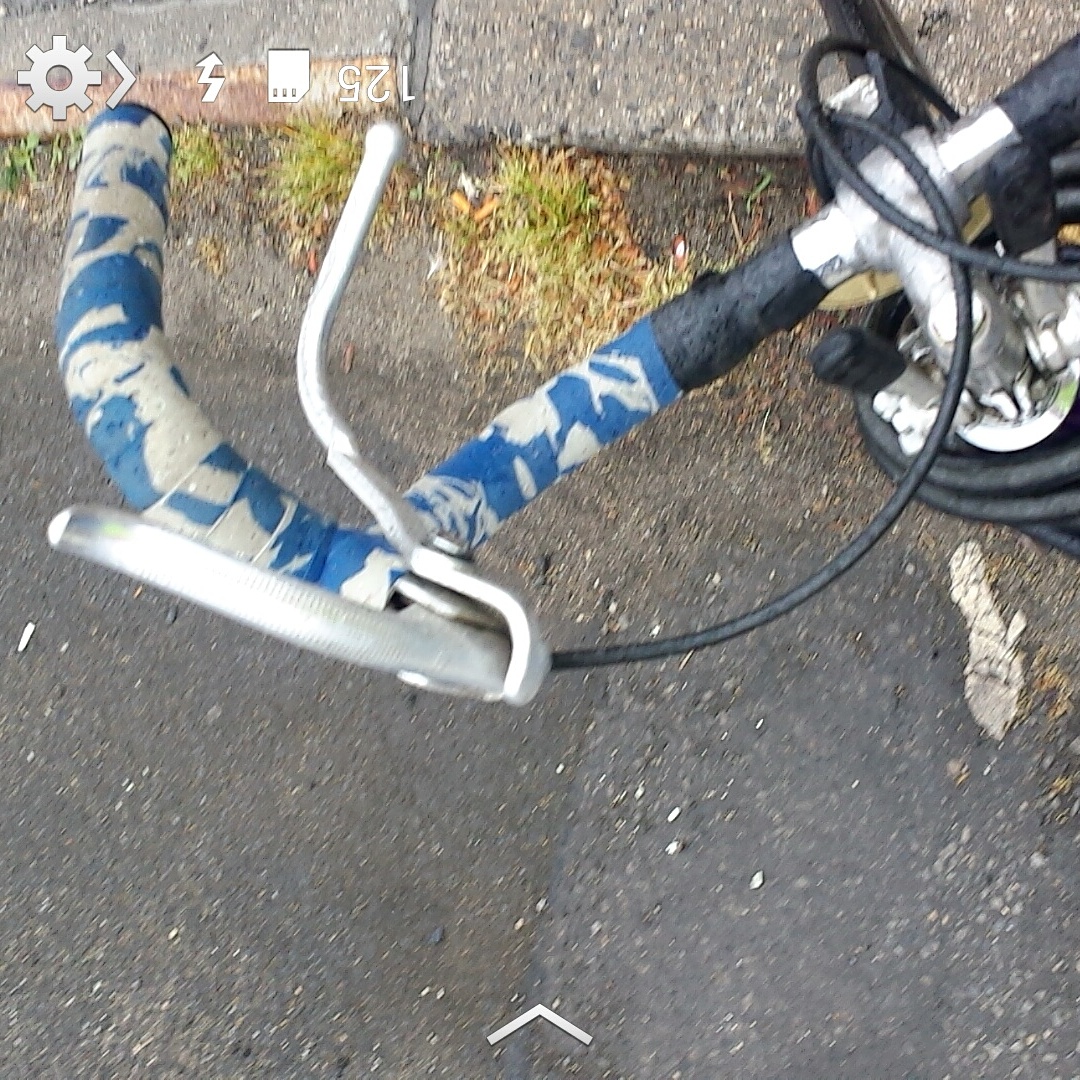
Then, with two library stops left, I did the inevitable miscalculation of my speed and level of anxiety while attempting to jump the curb on a road bike (Note: skinny smooth wheels, very little tread); bad angle + bad execution of curb hop= total handlebar wipeout. The result is this lovely photo:


I must admit, this is a very awesome vantage point, one I didn't think was possible as I became airborne and slammed my (thankfully) helmeted head into the sidewalk. Somehow, my smartphone took a very smart photo, and managed not even a scrape as we both clattered to the ground! I was stunned for a while, and definitely scraped and bruised, but my phone was solid. 

I can honestly attest to the quality of Gorilla Glass. In the demonstration at WITS 2015 and in my own altercation with a Brooklyn sidewalk, Corning Gorilla Glass 4 helped protect the scrapes and bumps of everyday life. 


In my little accident, I learned how to be prepared for the worst by wearing a helmet and giving myself time to recover before hopping back on that bike. This is what we traveling WITS women do, toughen up and get out there, not being scared of a shortfall, but always pushing forward to the next level of development and success. Definitely "tough, yet beautiful". I look forward to purchasing and using more devices featuring the added protection of Gorilla Glass 4.


This blog post was sponsored by Corning Incorporated. I received compensation for writing this review, but all opinions are completely my own. I stand by my statements.

Tuesday, March 17, 2015

March NoMadness: Finding My Purpose Through Women's History Month's Prime Directive

So the winter is finally loosening its grip in New York City, however minutely.
To be completely honest, I can attribute all of these mad ideas and objectives to a certain fateful epic roadtrip in mid-February, and my #shenanigans partner, @MicklaLittlefoot. This is all her fault and for that, I thank you, love!

Having joined the Nomadness Travel Tribe (at least the first hurdle) and purposed in my heart that this is the year for my writing and traveling to take off towards a new career, things are surprisingly taking shape. One of my scariest hang-ups has always been prioritizing my debt and other financial obligations, to the point of feeling paralyzed and shaking in a ball in the corner.

Not this year, dammit!

Wherever I can cut corners, carve new paths and make new opportunities to earn points, $$, favors, connections, accolades, and sponsorships, I'm open and searching!
It is overall a more positive outlook, as I aim to streamline the content and direction of this blog.

My mission still involves singing, teaching flying, and, of course, writing. I yearn to blaze a trail my grandmother embarked upon flying to England from South America in the 60s, then to Louisiana, Toronto, Washington D.C., for her children, but, ultimately to do better for herself, by way of helping others.

As I become more acclimatized to the Twitterverse and Instagram, I begin to understand how this technology is really addictive and full of possibilities for great connections. I am joining the bandwagon/bus ride/#RyanAir #cheapticket, lol! Hit me up people, I will travel for work, will work for travel!